
For severe winter conditions—including packed snow, slush, and black ice—(Mud & Snow)
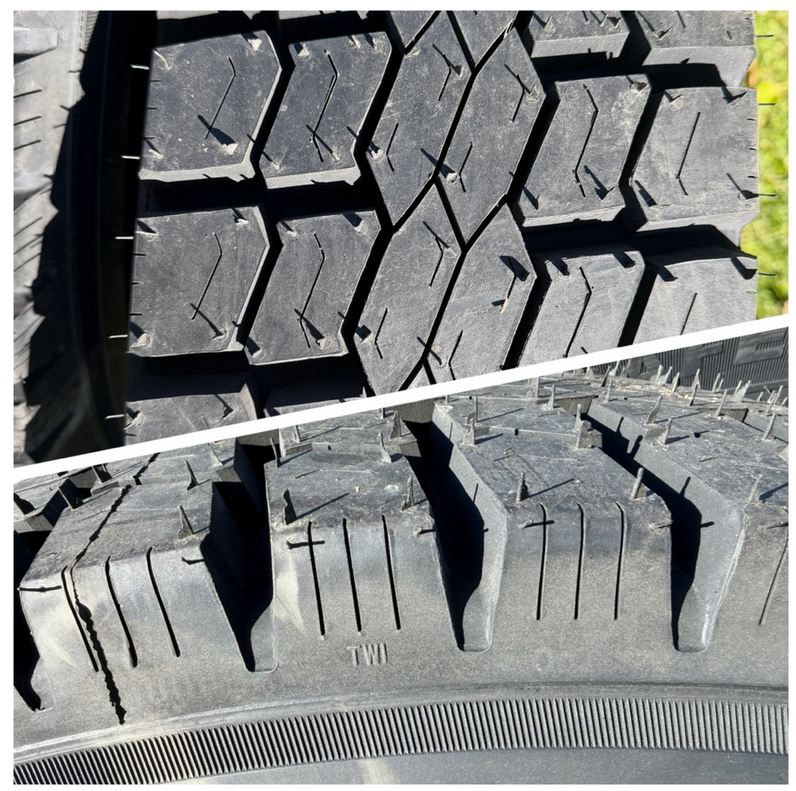
the real-life photos of your tires, the tread patterns are nearly identical visual clones. Both tires utilize the same open-shoulder multi-lug layout with chevron/arrowhead center tread blocks and micro-siping in the middle.
The catalog product photos can be misleading, but seeing the physical tires side-by-side clarifies how close they are:
Key Visual & Design Similarities
-
Center Rib & Chevron Blocks: Both tires feature the exact same center interlocking chevron pattern with thin sipes cut through each block to assist with wet and snow traction.
-
Open Shoulder Notches: Both tires are true open-shoulder drive tires in person, featuring deep gaps between the outer blocks to clear out mud, gravel, and snow.
-
Tie-Bars & Wear Indicators: Both feature small tie-bars at the base of the outer shoulder grooves and standard “TWI” (Tread Wear Indicator) markings stamped along the shoulder edge.
Advance AV7000L 24.5
Advance GL-293D 11R24.5

Matching Tire Diameters & Rolling Circumference
Because the two models carry different load ratings, set your cold inflation pressures accordingly
- Rear Axle (Advanta AV7000L – Load Range H / 16-Ply): Run 110 to 115 PSI cold[cite: 5]. This allows the stiffer casing to support heavy payload weight without excessive sidewall flex or heat buildup[cite: 5].
- Forward Axle (Advance GL-293D – Load Range G / 14-Ply): Cap at 105 PSI cold[cite: 5]. Do not over-inflate a 14-ply casing beyond its maximum sidewall rating[cite: 5].
Summary Checklist
- Never mix them as a dual pair on the same hub side (keep 16-ply with 16-ply, 14-ply with 14-ply across each axle).
- Maintain 110–115 PSI on the 16-ply rear axle and 105 PSI on the 14-ply forward axle[cite: 5].
-
Verify wheel rim pressure ratings on your Freightliner to ensure your rims are rated for 115 PSI cold service.

 Loading ...
 Sell Your Truck
Leave a Review.
All Ratings & Reviews